October was a month of God’s help for endurance. As I met with Jesus this month, he did a tremendous amount of work on my insides so that I will be able to move forward with more grit and joy.
Simple Pleasures
This month, my friend Kara and her friend came Northern Virginia for the Voice of the Apostles conference! After work, I met them there for the evening sessions. God conquered last minute travel logistics and health issues to speak clearly.
This session was aligned to much of what God has been showing me this month about meeting him on the cross.
My students reflected on what they’ve learned about Identity through art! Check out this video to get a sneak peek of what they’ve learned.
This month, Fourth grade presented their Inquiry Projects on DC Community. I was abundantly proud of them, but especially this student who joined our class at the beginning of the year. As someone who is at early levels of English proficiency, he gave a bilingual presentation to the class. It’s been a joy to see his language skills begin to blossom!
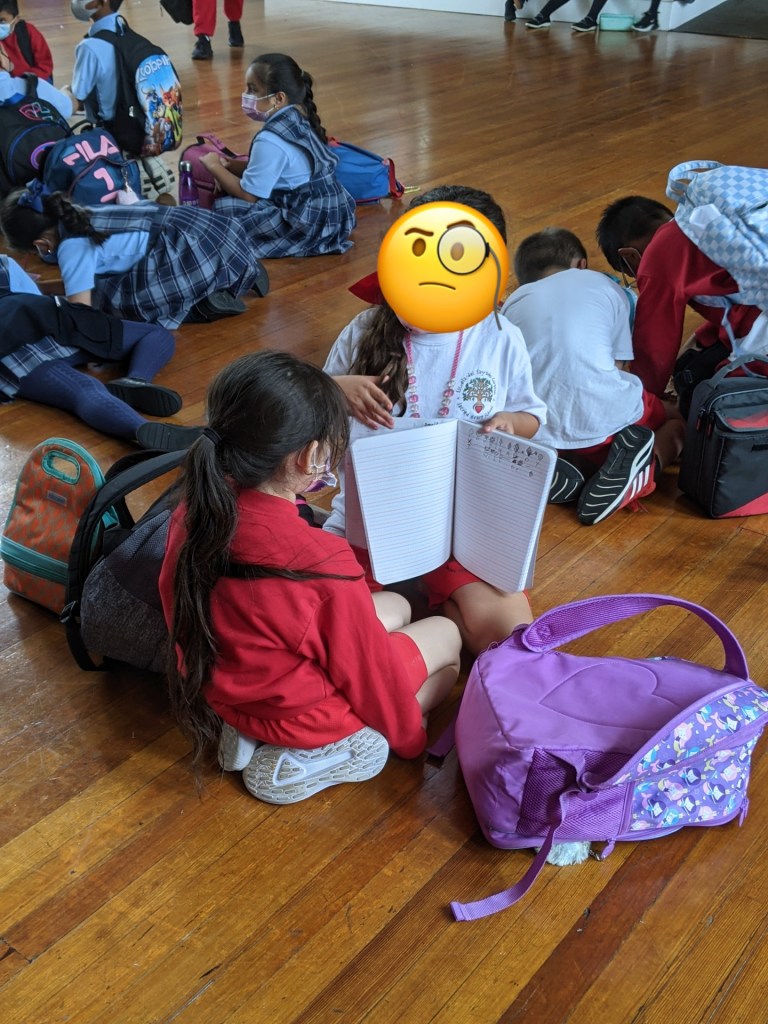
This month, several students were inspired by a small group reading book to write their own secret codes for home use. Here, one student is explaining her code’s symbols to another.
Third grade found various ways to model division!
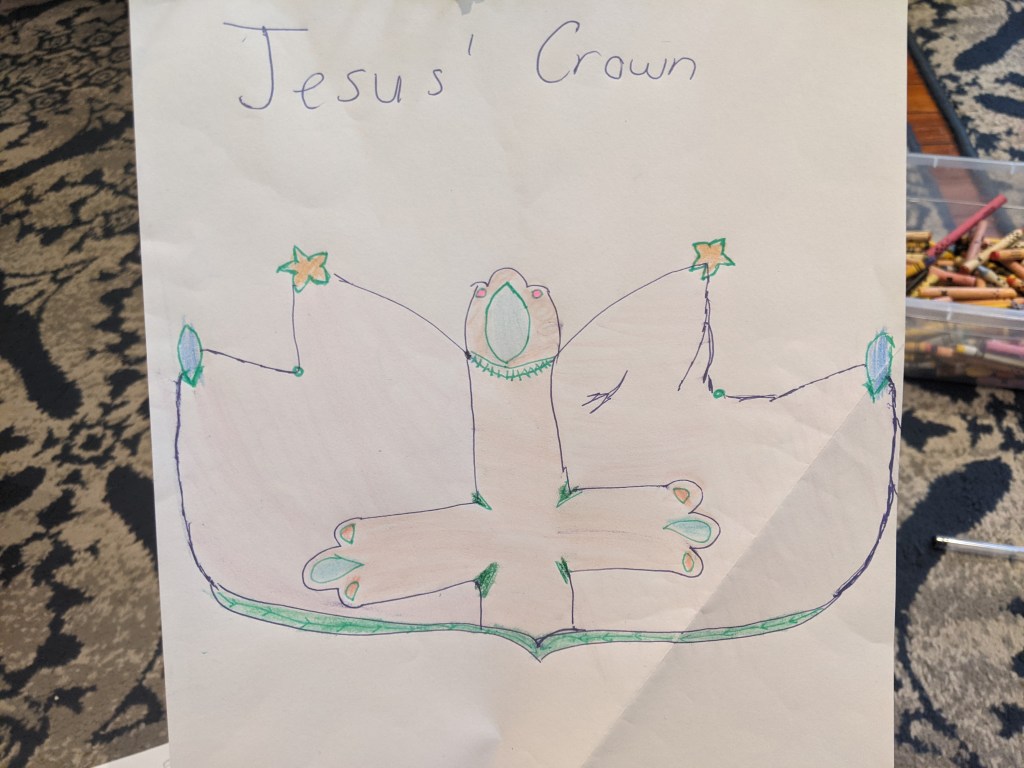
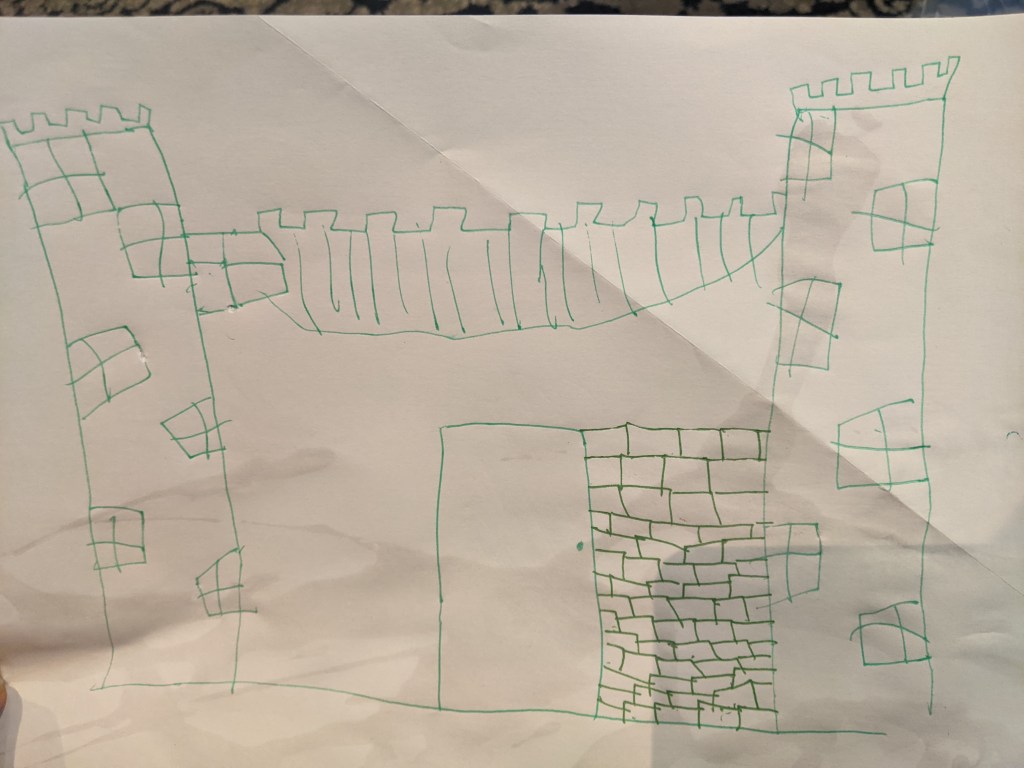
At the house church I attend, several young members helped me color in a crown for Jesus and castle as we worshipped him as King.
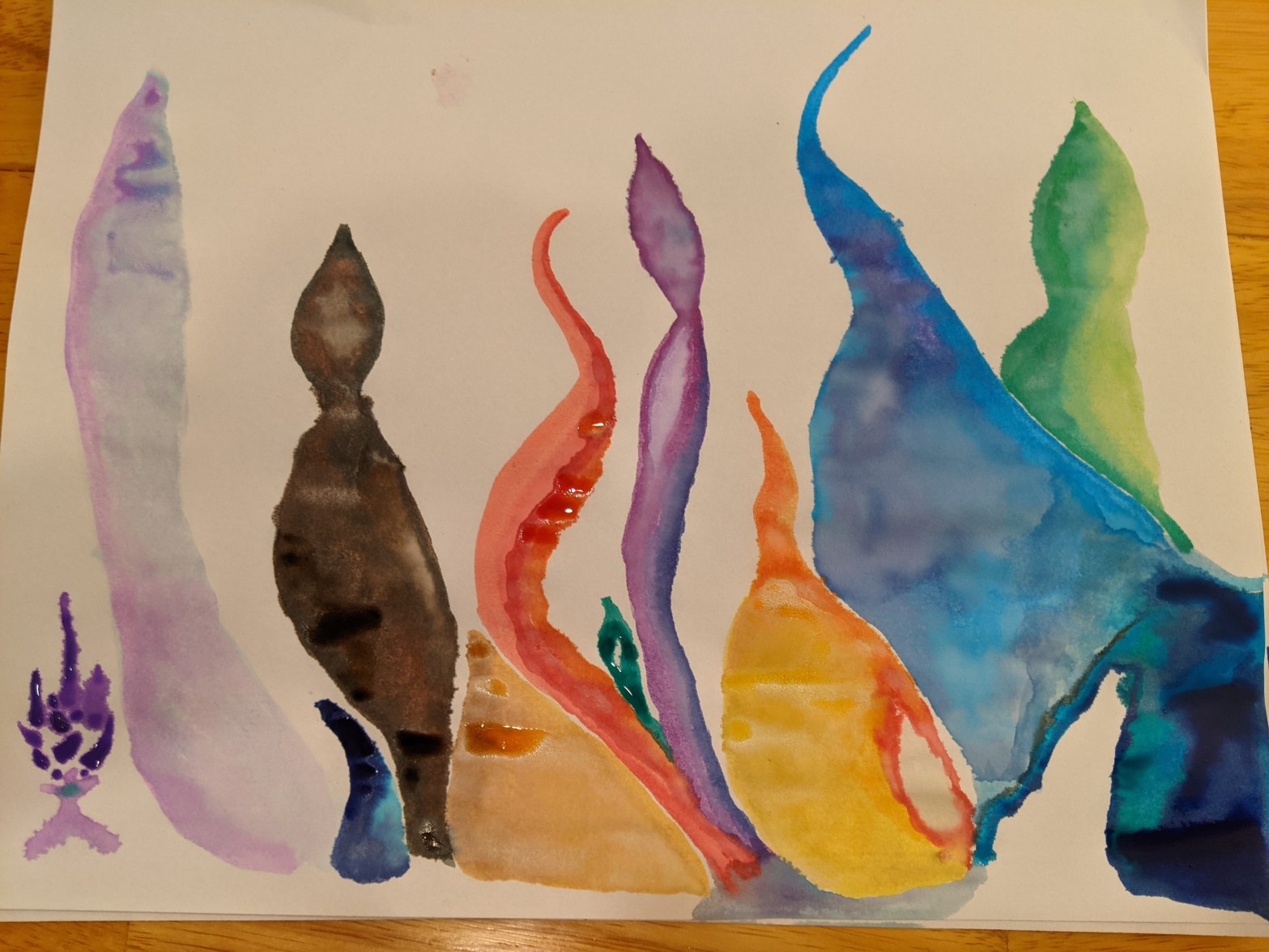
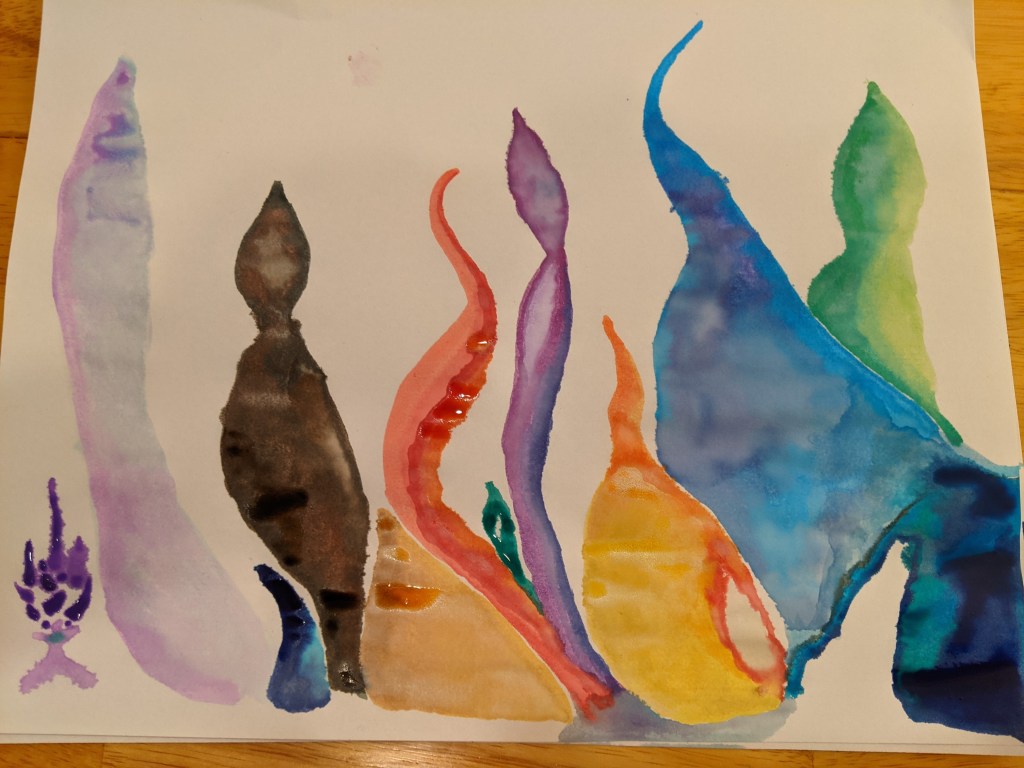
My friend trusted God to launch some prophetic painting workshops! Here is a reflection I painted on the moment in 1 Kings 19 when God calls Elijah out of the cave.
Celebrating good news in advance with Ada Ehi’s “Congratulations”
Themes this Month
Yearning
Healing honesty, Spirit of Truth
Meeting Jesus on the Cross, Endurance
Salt, The Greatness of God
In my dreams: Leaving my students on field trips to play like a child
God bringing me flowers, the faithfulness of his love
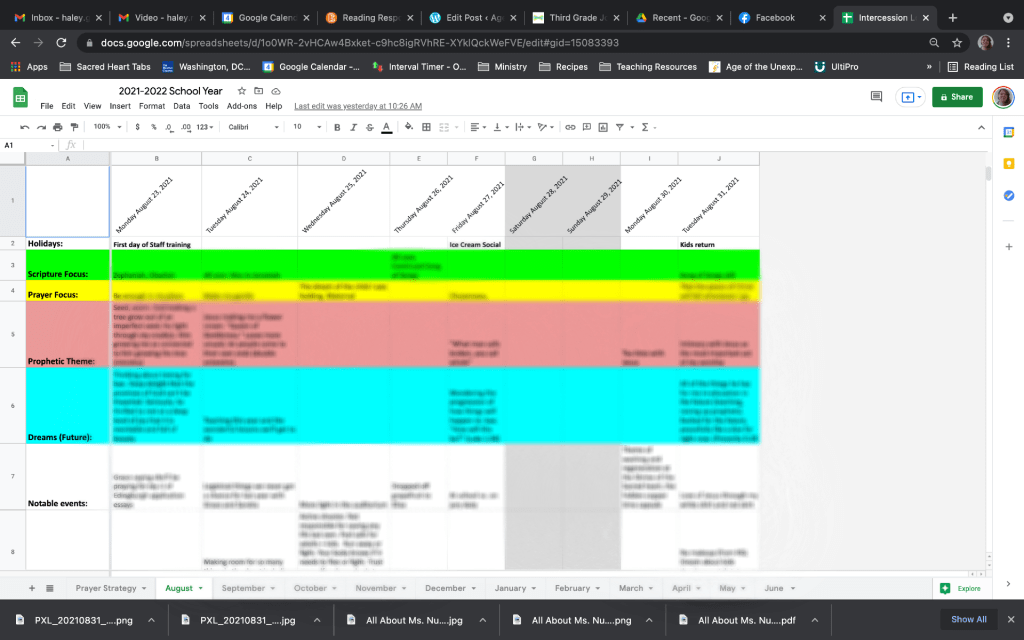
This month, my discerning of spirits took dramatic leaps forward! In counterbalance to some of the things God’s been showing me, he has been inviting me into an even deeper rest. For the sake of maintaining in endurance, I have it on my calendar to meet with him in specific locations in the Heavenlies on certain days. He keeps naming and showing me new places.
Radically Different Abilities, Radically Different Approaches
Lately, I’ve noticed some large developmental differences between my classes. The majority of my current Fourth Graders (last year’s Third grade) are blossoming, trading in much of their former dependence and anxiety for greater academic and developmental maturity. My current Third graders are somewhat academically stronger than my group last year, but have a great deal of emotional learning before them. As someone who started teaching at this school in August 2020, I don’t know what it would be like to teach in this setting without the influence of the pandemic. As someone who taught second grade for years before the pandemic, I can say for certain that these students are capable.
These developmental differences are shaping the way I teach them about God. Since Fourth grade was with me last year, many of them have caught a great deal of zeal for the Lord. I say caught because to be honest, I taught them many things but only the Holy Spirit can soften hearts. With this group, my goal is to build on their hunger so that they will increase in intimacy with Jesus.
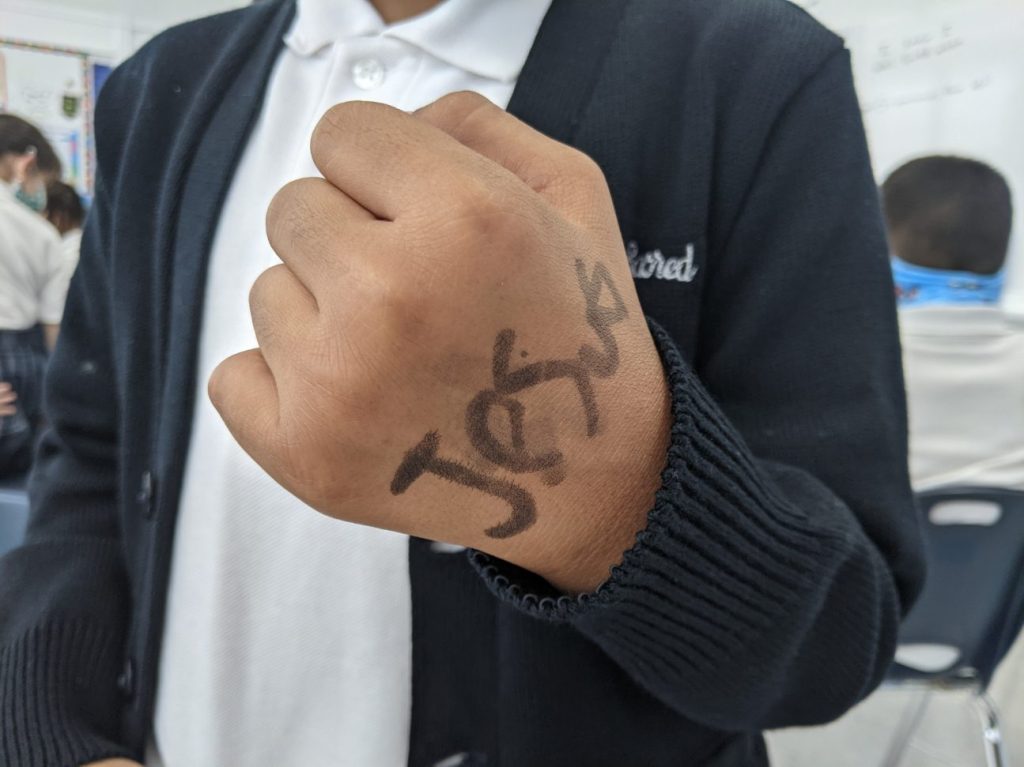
Due to all of that investment and the work of God on their hearts, these are the some of the questions Fourth graders asked in October, when given the opportunity.
Third grade is coming to me with much less background or expectation of the nearness of God.
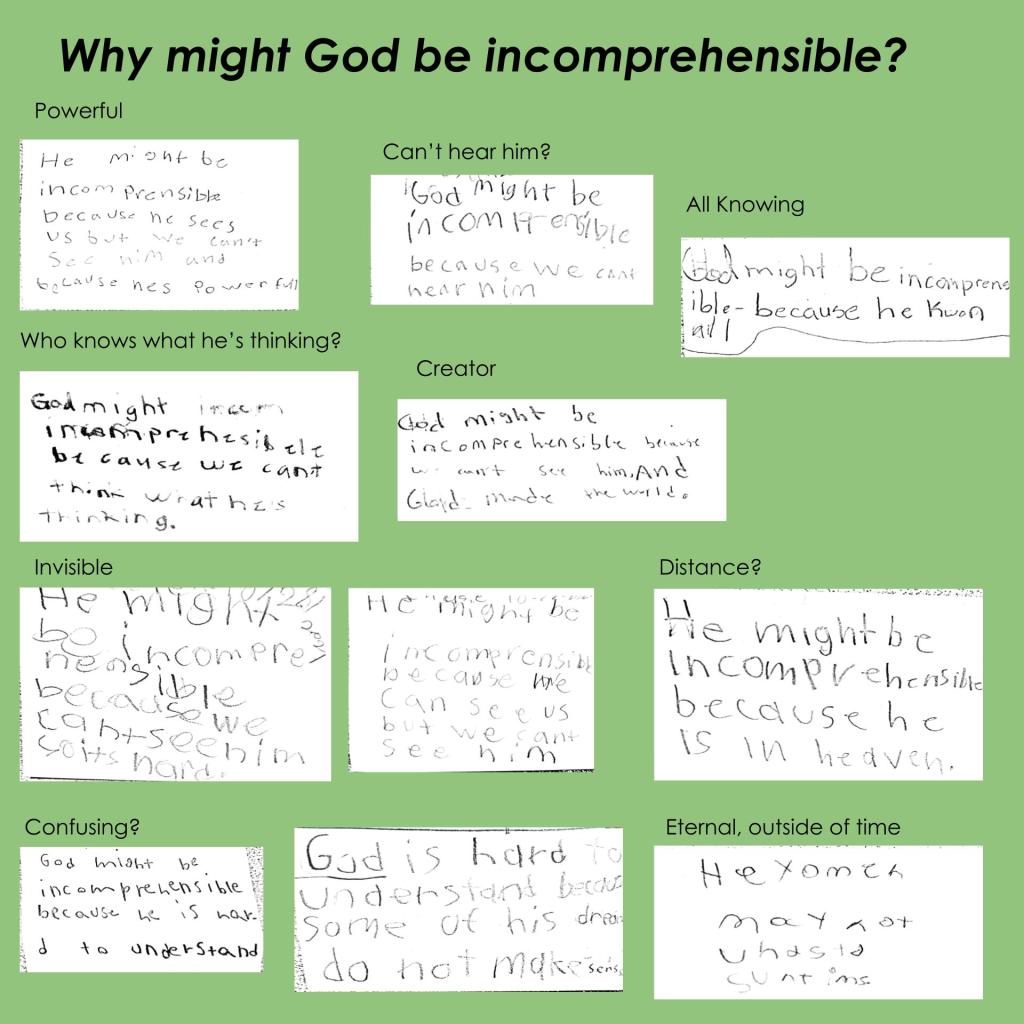
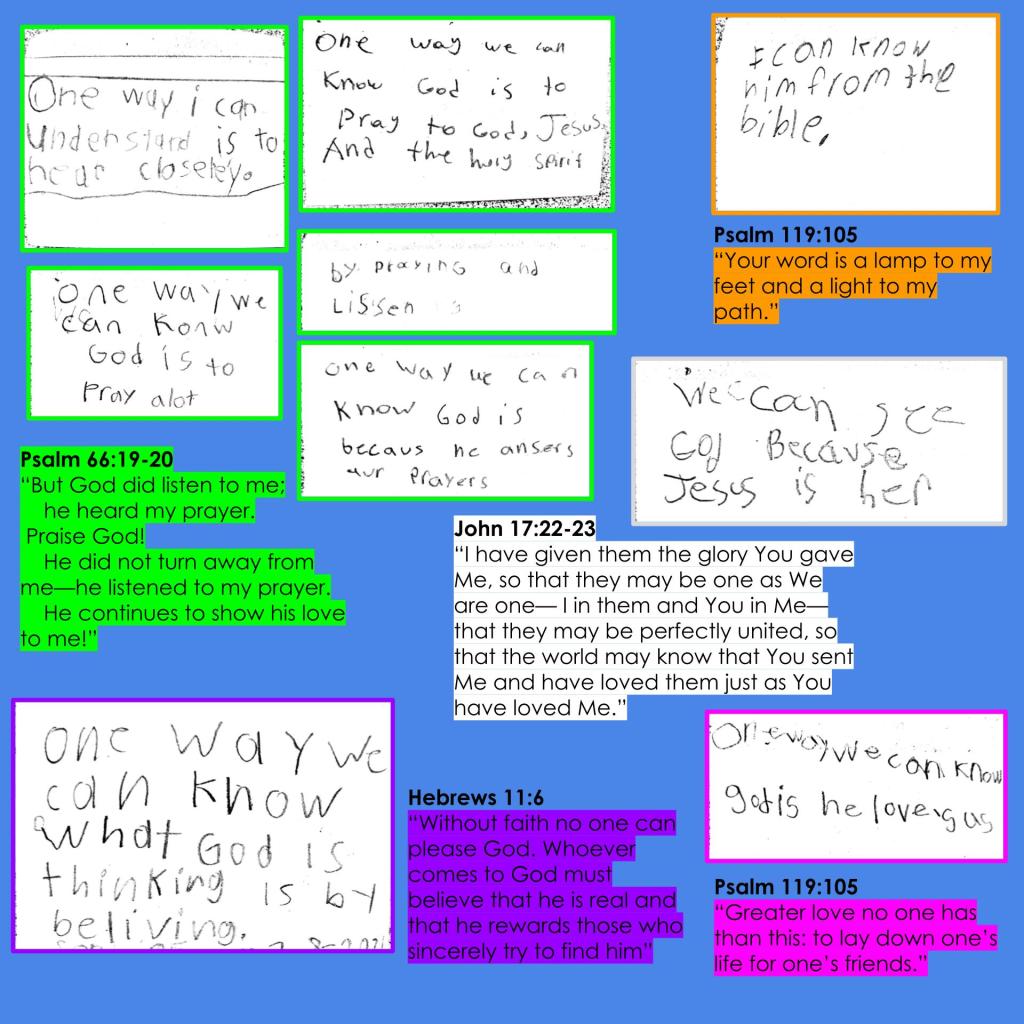
In order to meet them where they are at, I have decided to acknowledge how simultaneously distant and close God can seem through our Word of the Day and a constructivist approach. With this group, my goal is to help them become more hungry to know God for themselves. I will be writing more about this in detail soon.
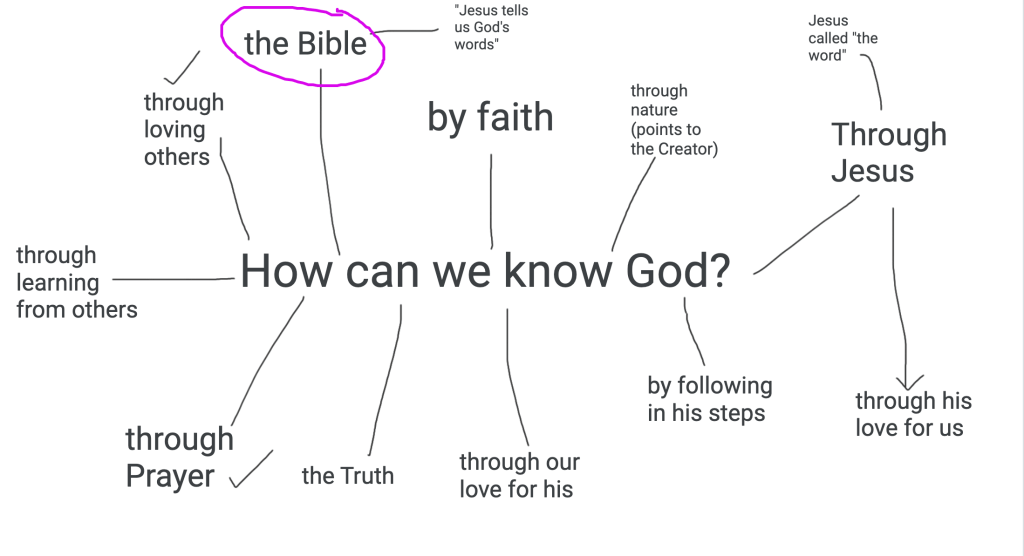
Their thoughts on Why God might feel hard to understand (before discussion):
Their thoughts on How we can know God (before discussion *verses added*):
Growing Awareness (after discussion):
Prayer Requests
Please pray:
That God would give me the grace to live vibrantly in a time of ambiguity (Romans 8:28)
To see the Heavenly host he’s put surrounding DC and stand on his plans for the city 2 Kings 6:17-20
That God would help handfuls of people I love to struggle well (1 Timothy 6:12, 1 John 2:14, John 14:3-4)
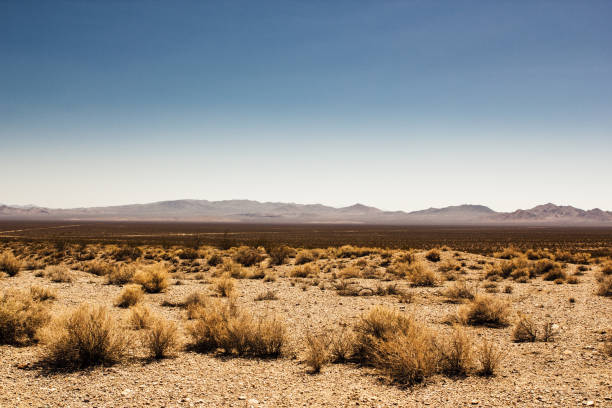
Now that many of us have emerged from the external solitude of COVID-19, some of us may still find that internally, we are still in the desert. For many Christians, this feeling of uncertainty is much like the uncertainty of coming to faith for the first time, when people are said to go through “the Valley of Decision”. While trusting God for the first time is difficult because it is unfamiliar and feels barren, throughout the Christian life, we will inevitably walk through the Valley of decision many times (Matthew 4, Luke 22:44). Each time, we are being invited into an encounter with the Lord (1 Kings 19).
Different Valleys of Decision may have different names. One might be called, “Can I be forgiven?” Some others might be called, “Who is first in my life?”, “Where can I find my approval?” , “What does it mean to live?” or, “Who can be enough?” As we wrestle with God to decide, we rename the places of our wrestling by the evidence of our decision (Genesis 32:30). For example, the Valley of “Who can be enough?” may be renamed, “Only the Lord is enough.”
In the Valley of Decision, we must allow ourselves to be led by the Spirit alone (Matthew 4:1). As we receive God’s invitation to meet him in the Valley of Decision, we encounter him, we are changed, and the way we relate to others will inevitably change.
Therefore, we must not resent others for needing to go to the valley alone, or be angry at others when they are not able to join us there (Mark 1:35-37). Instead, when we see our friends or family going through the Valley of decision, we must change the way we pray. So how might we pray for ourselves or others, as they travel the spiritual wilderness alone? Based on the bible, there are a handful of ways we can pray. If you are the praying kind, I challenge you to spend a few minutes today praying for someone you know who is walking through the Valley of Decision, actively entrusting them to God through prayer.
A Blessing for the Valley of Decision
I bless you to receive the invitation of God to meet him in the wilderness (Matthew 4:1).
Instead of just leaves as your covering (Gen 3:7), and instead of our imperfect humanity (Gen 3:21), I bless you to be strong in the Lord and in his power (Ephesians 6:10).
I bless you to neither be afraid or discouraged, but to know that the Lord goes before you. He will never leave or forsake you (Deuteronomy 3:18). I bless you to not be hurt by the inevitable fragility and scattering of your friends, but to see clearly that the Father is with you (John 16:32).
I bless you to fight the good fight of faith (1 Timothy 6:12), to stand your ground, and after you have done everything, to stand (Ephesians 6:13).
I bless you to receive the blessing that comes from wrestling with God, and to allow your identity to be changed (Genesis 32:22-32).
As you wrestle, may your ears be blessed because they do hear, and your eyes be blessed, because they do see (Matthew 13:16).
As you encounter the Lord and as you receive a new name, may it redeem the way you relate to others (Genesis 33). May the Holy Spirit continue to guide you into all truth, and reveal more and more to you as you can bear it (John 16:12). May the Holy Spirit reveal to you your inheritance through the depths of the Father’s love for you (Galatians 4:7), and make known to you everything that belongs to the Father (John 16:15). As you make the Lord your refuge, he will certainly rescue you and show you his salvation (Psalm 91:16).
This month, the majority of my energy was shared between two different areas: in support of my city and in supporting my students to adjust to the new school year.
An Energetic Return
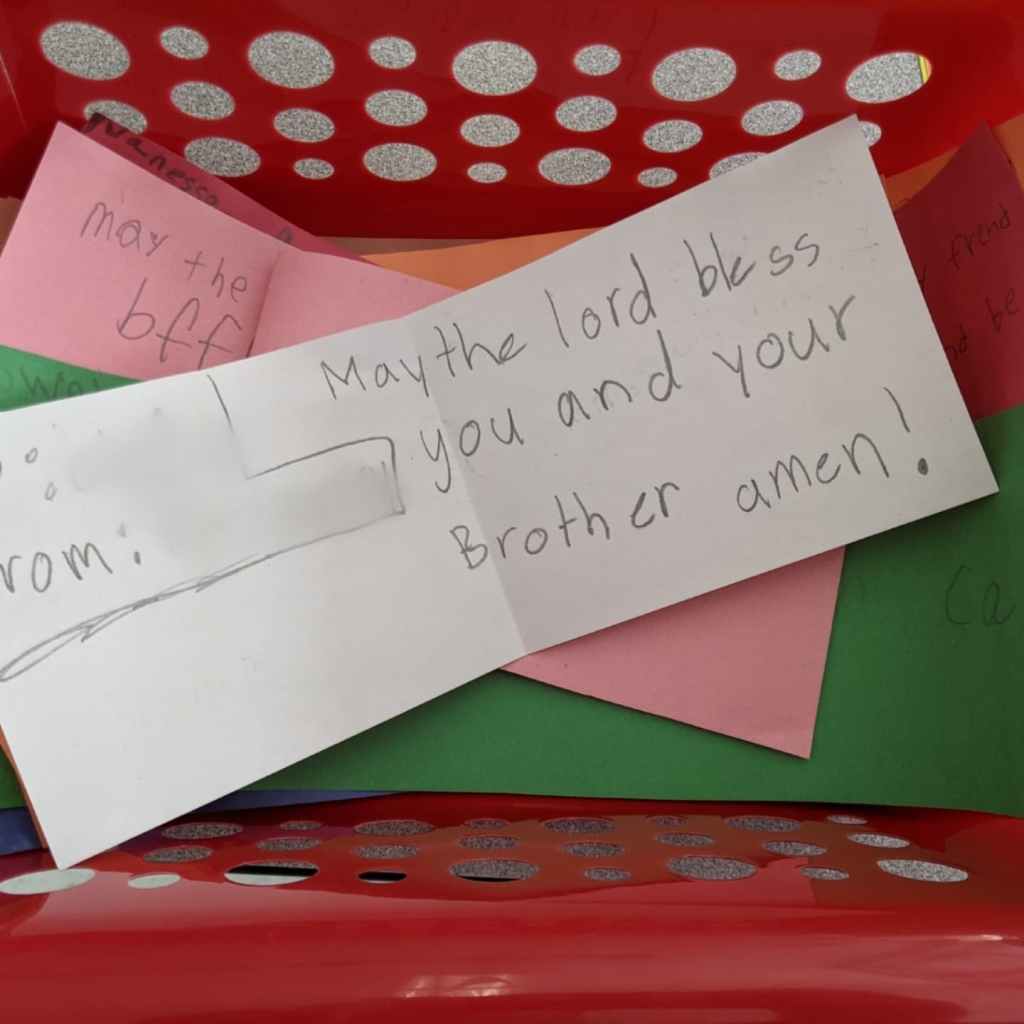
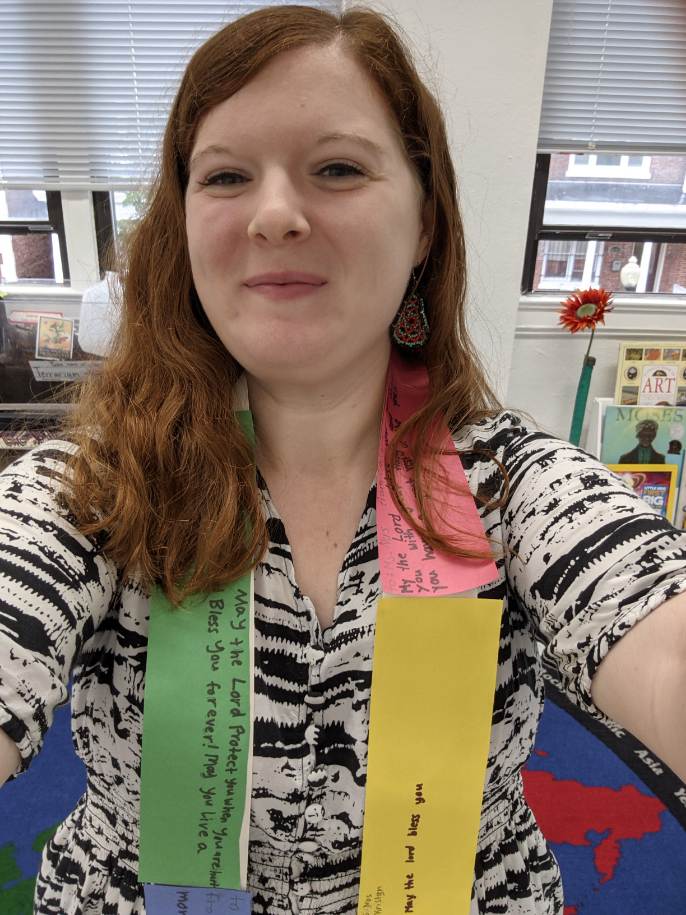
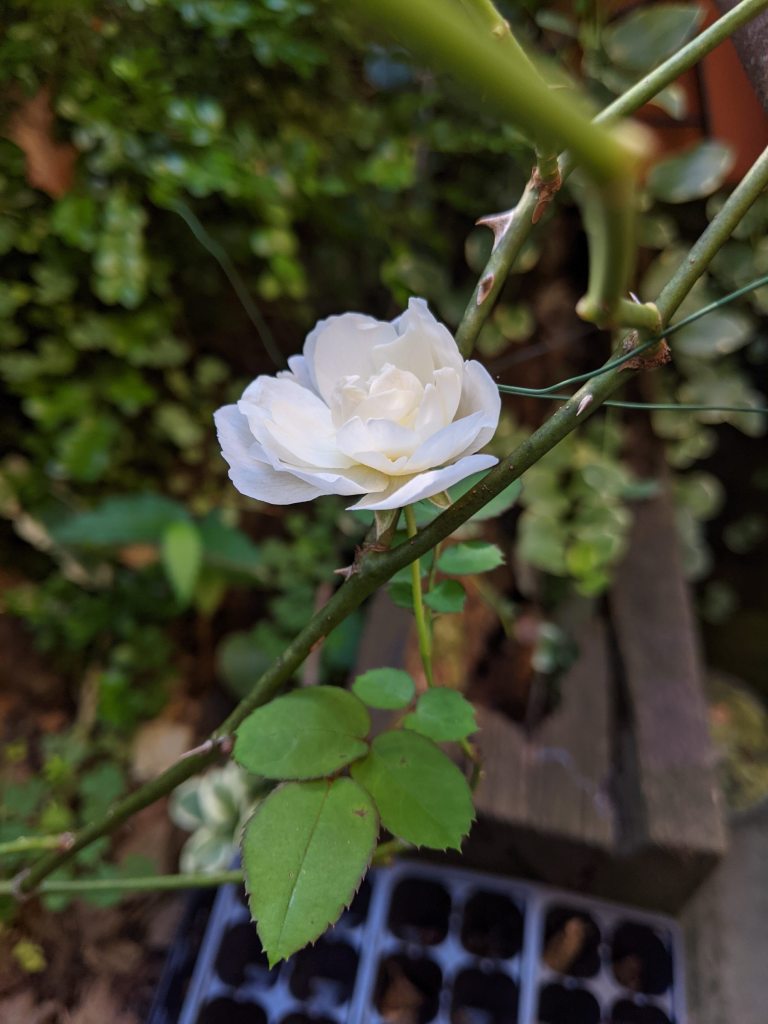
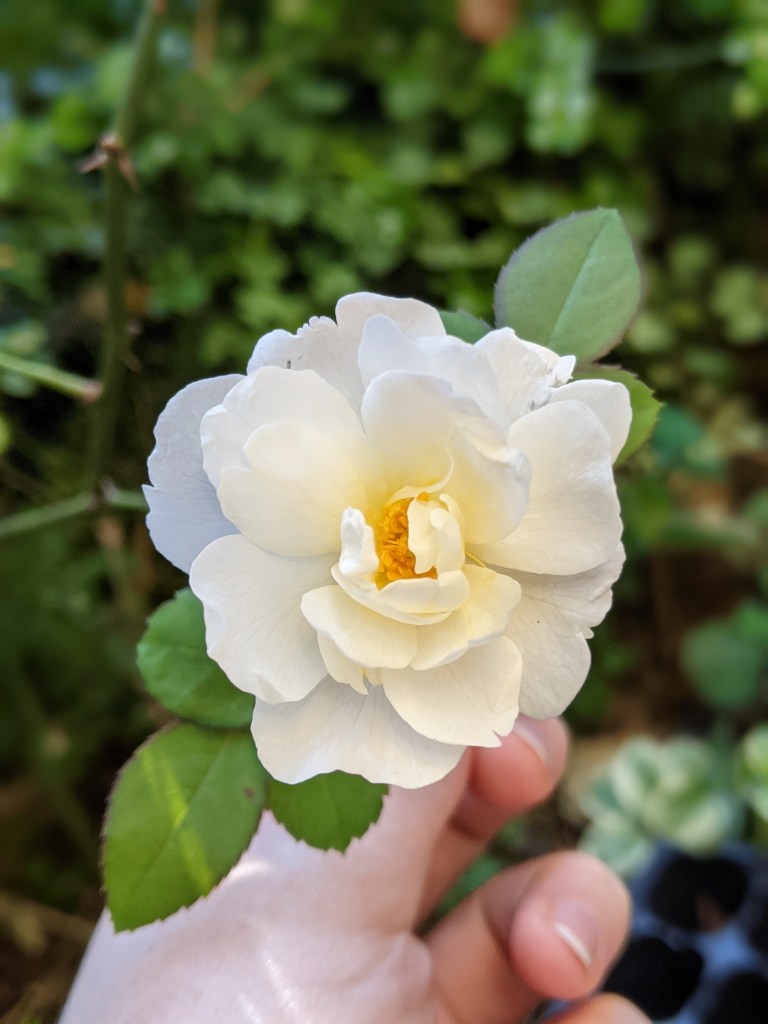
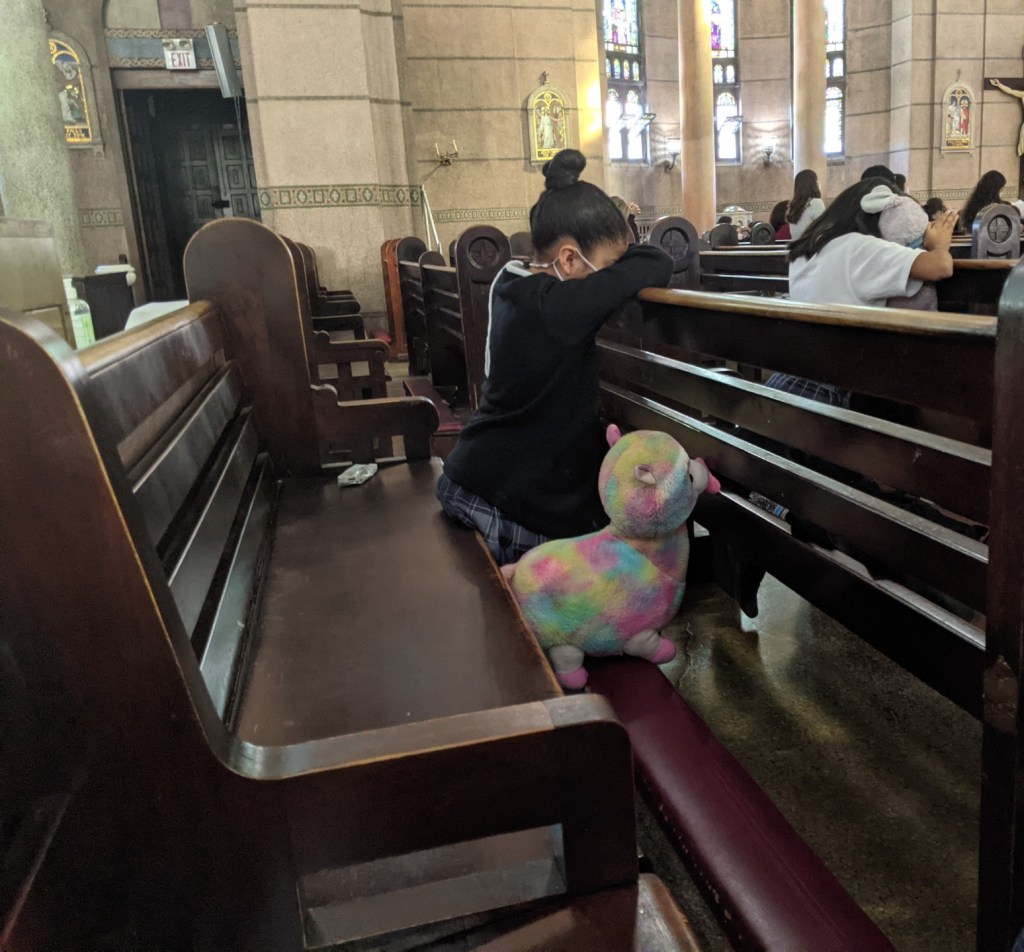
Sons, not orphansSlime making celebrationBlessing one anotherHosting my co-teacherDressed in blessings from my studentsPraying for my cityPrecarious but beautifulIn the middle of the shaking, God made my “encouragement” rose bush bloom againContinuing to invest iin DCCelebrating God’s creation through stuffed animalsEncouraging our stuffed friends to trust God
Ministry at Work
As the school year has inched towards normalcy, I’ve noticed increasing levels of favor with students in other grades, with students’ parents, amongst others in my school district reaching out for help, and with other colleagues. Beyond the students I met teaching aftercare as a substitute who consistently ask when I’m coming back, I have one first grader who likes to visit me and send me heart-melting air hugs at dismissal. According to his teacher, he regularly says that I am his favorite teacher. It must be the Holy Spirit, I’ve only seen him in passing and his joy is a blessing.
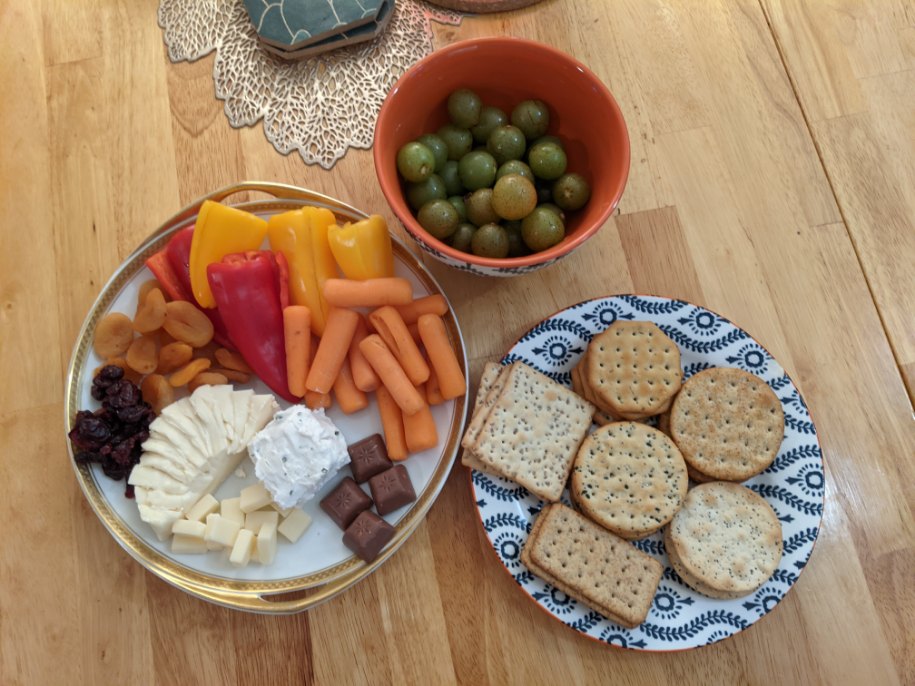
I have been so grateful to begin developing a friendship with my new co-teacher. She is an experienced professional who is also tremendously kind and creative. I can honestly say that this is the first time in my 6 years of teaching that I have been able to work this closely with someone else on my team with such a high degree of mutual support and agreement.
I am excited to start a tradition of praying for students’ on Mondays with my co-teacher. While I have used discernment, seeing in the spirit, and strategic prayer independently since I’ve been at this school AND have even been able to invite colleagues to do so before difficult meetings in the past, this is the first time I’ve had consistent support. As might be predicted, I have a list of several students that we’ll be praying for tomorrow with the specific difficulties they’ve had lately and bible verses that will allow us to pray into the root.
Increasing Ministry to DC
A shocking 95% of my seeing in the spirit this month had to do with God inviting me into greater personal responsibility for DC as the place where I live. While this is far from my first time interceding for the city, God has stressed to me the importance of gathering a support group of people not just called to the gift of prophecy, but the office of a Prophet. As God surrounds me with others who have a similar orientation, my prayer is that we will be able to do biweekly prayer calls, prayer walks, and build friendships to combat the difficulty of the city’s spiritual terrain.
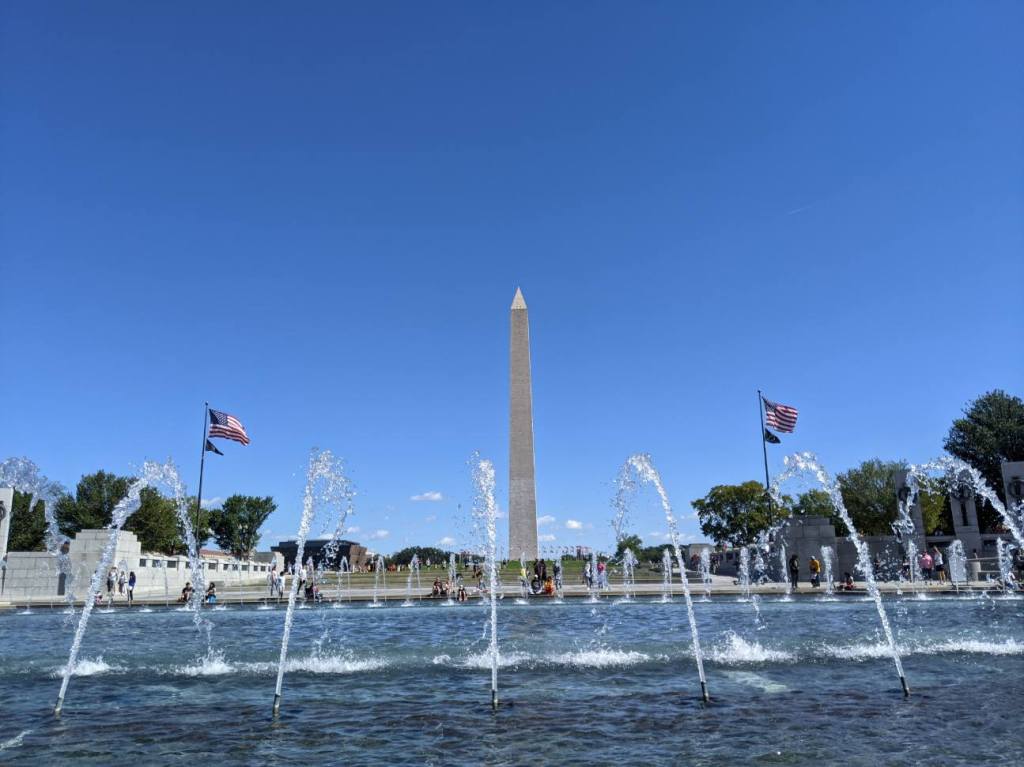
For that reason, I have been more intentional to invest in local friendships with others also called to supernatural ministry this month. With a friend, I was able to walk and pray over the Capitol building in DC before protestors arrived on September 18th, including the side of the building that insurrectionists had breached last January. We also prayed over the Supreme Court building for similar reasons.
I was also invited by another friend to accompany her in her street ministry with the homeless around Union Station. I hope to be able to be able to partner more intentionally with her in the future, to supplement the incredible relationships she’s built with tools like seeing in the Spirit. Lately, my seeing in the Spirit has become more fluent, which has been a joy and an adventure.
This month, I have needed to not just track my dreams or independent seeing in the spirit, but start to track signs and shared seeing in the spirit with friends. This month, one of my close friends and I have been able to build on each others’ images and get different aspects of the same phenomena as we pray. As the visionary side of the prophetic becomes more and more fluent, I hope to be increasingly aligned with the Holy Spirit in all aspects of my life.
Favorite Book this Month
A well timed book can be such a blessing! This month, I’ve been reading on prophecy in the first and second century after Christ. Specifically, this book examined differences in prophecy among early Christians, pagans, and Greco-Romans. Throughout the book, the author describes various methods that pagans, Greeks, Jews, and Romans in these cultures would use to seek the divine. This list isn’t exhaustive, but includes: Amulets, spells, horoscopes, physiognomy, incubation, alchemy, augury, consulting entrails, lots, dice, mirrors, oracles, prodigies, palms, sieves, forms, figures, palms, dishes, lightning and thunder, and the most hilarious of of all, cheese.
This book also describes how Christians in the first and second centuries approached non-Christian prophecy in method and interpretation. Regarding methodology, there were various Early Christian prophets who did not initiate encounters but were led by the Holy Spirit and whose words were confirmed by scripture. Related to interpretation, Irenaus, an early church father declares, “Heretics think that the scriptures are ambiguous and that one needs to use outside information to interpret them”. Irenaeus (like many modern prophets) believed that the prophecies in scriptures self-interpret one another, without any need to add to the word of God (Rev 22:18). The book describes times where Early Christians took an apologetic, conciliary approach by appealing to their audience’s background in pagan prophecies to show how even these prophecies pointed to Jesus. There are also examples of times when Early Christians took a polemic approach, specifically condemning divination and contrasted it with Holy Spirit led prophecy and methods. In reading this book, it’s easy to understand how many pagan, Jewish, Greek, or Roman individuals would have understood Jesus to be a prophet based on their traditions, but would have needed the revelation of the Holy Spirit to know him as Messiah. It puts new context on verses like Matt 16: 13-20, John 1, 2 Timothy 4:3, Acts 16:16, Leviticus 19:26, Leviticus 20:6, Revelation 22:15, Revelation 21:8.
Finally, this book highlights several cultural phenomena whose history should give us greater fear of the Lord. First, the book highlights the Roman empire’s dependence on prophecy and ambivalent fear towards and dependence upon nationalistic prophecies. Secondly, the book highlights the thematic transition in early rabbinic Judaism between waiting for a messiah to instead focusing only on the teachings of Moses through Pseudepigrapha and ethically following the law. It is important to note that as these these individuals reformed their tradition to no longer prophetically anticipate the Messiah, the Second Temple was destroyed (Jesus foretells this destruction as part of the religious leaders’ rejection of him in Mark 13).
For me, August had each foot in very different continents: the left foot stood in visiting family, while the right foot firmly stepped into the new school year.
Visiting Family in the Pacific Northwest
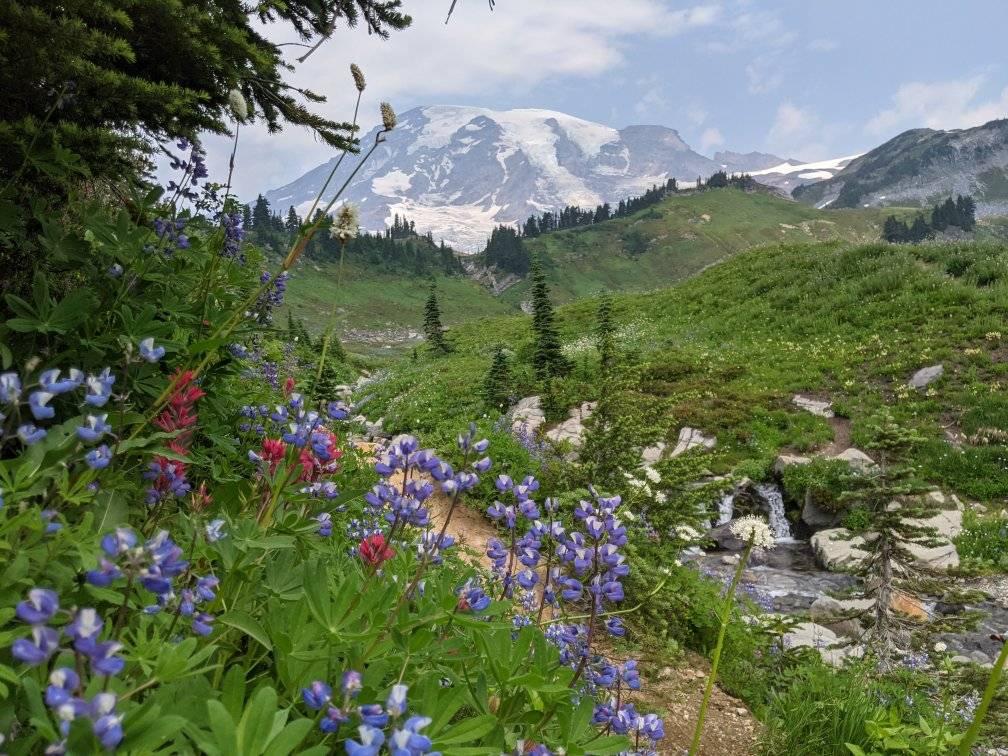
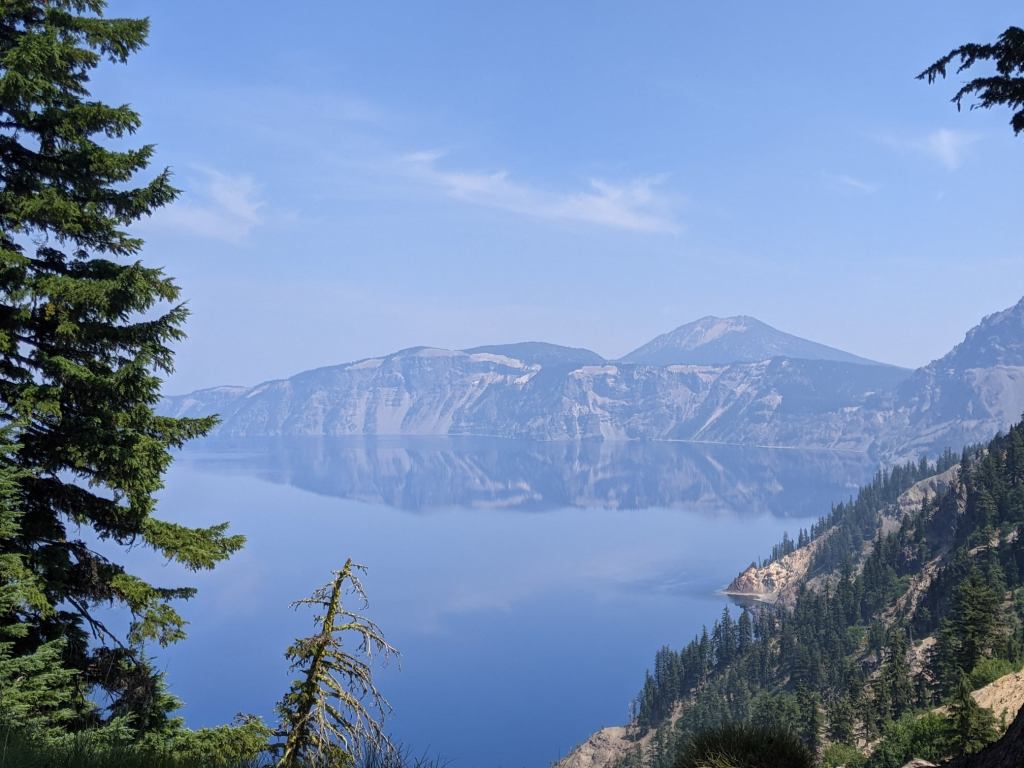
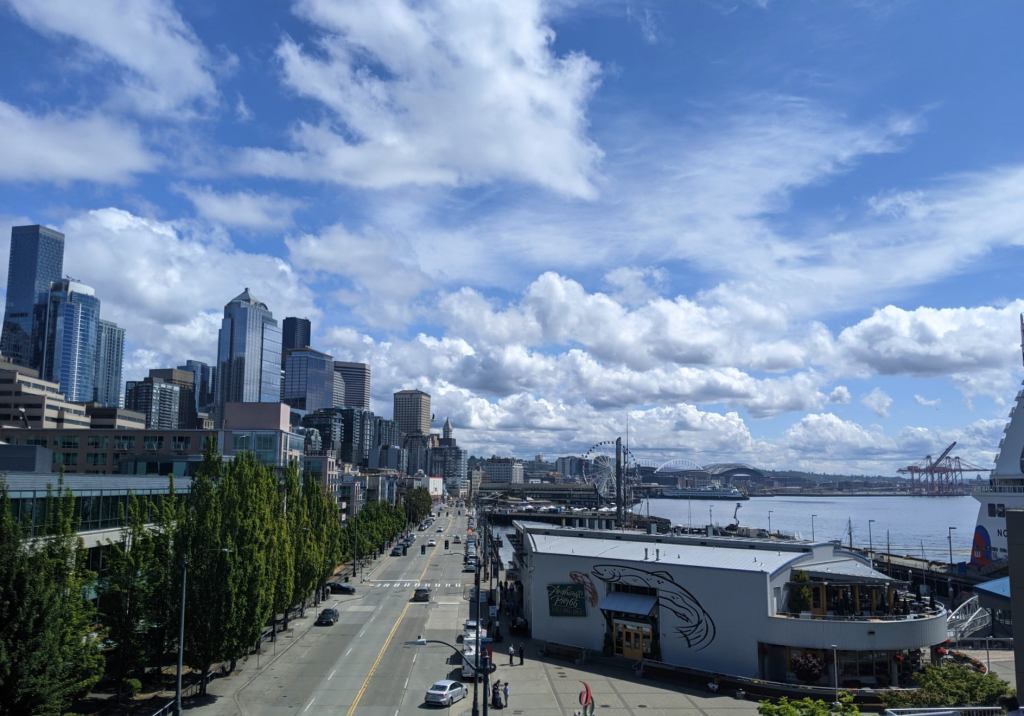
In visiting my family, I saw mountains in every city I stopped through. I saw my mom and sister, Dad and stepmom, aunt and uncle, brothers and their families. From Seattle to Southern Oregon, Northern California, and ultimately Denver, I was travelling for two weeks!
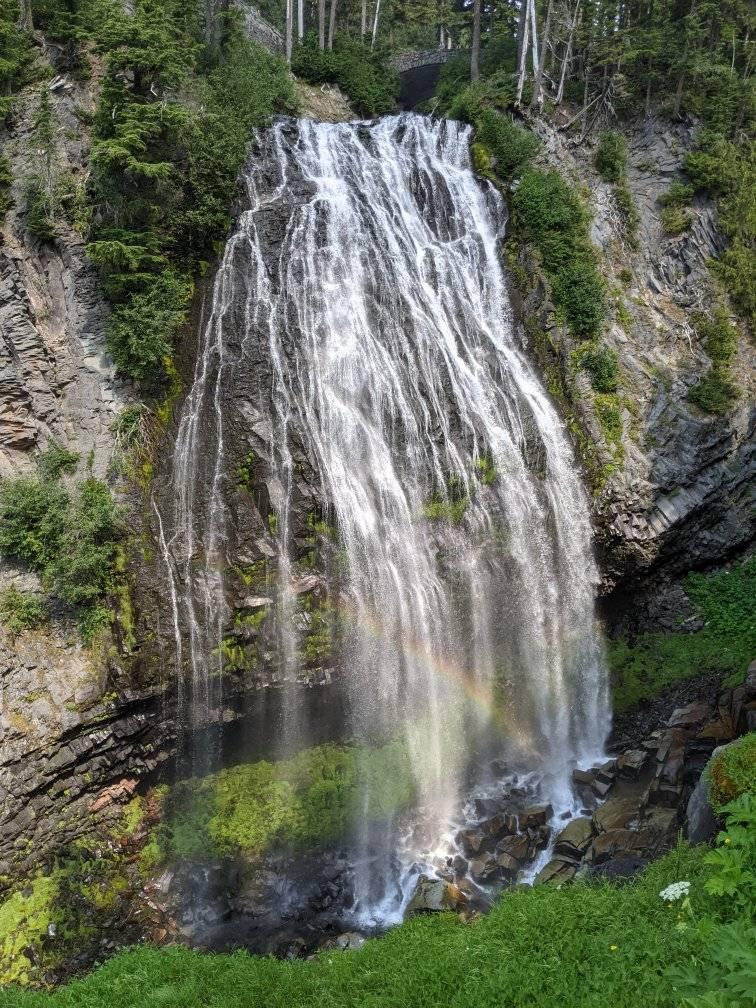
Molly watching me through the windowMount RainierCrater Lake National Park
Back to School
Just one week into the school year, the amount of classroom resources and favor for student curiosity, relational cohesion, and directional clarity we have is unreal.
With the beginning of the school year and in light of the abundance of favor that is on my classroom, I’ve been asking God for a new prayer strategy. While last school year often felt like a perpetual battle in prayer, my approach to this school year has more to do with me being available for intercession, but spending more time watching and listening for God to highlight what is important in a passive sense. At the same time, I sense he’s calling me to focus on deepening relationships with staff and students as a way to establish the work he is doing, especially as I receive more dreams related to how to intercede for them individually.
As we come back to school, the theme of Identity continues to emerge. As I get ready to teach on Christian community to help us form our sense of classroom family, I have decided to set some time aside to first cover identity in Christ. Since people of all ages cannot know how to engage well with those in their community (or community of faith) until they have a clear sense identity, theology of the individual has to come before theology of community.
As someone who started this position during distance learning, I have so greatly enjoyed seeing students again and for the first time as entire classes. They are so hungry to be known and to know others that we’ve already been able to form relatively strong connections. I have the benefit of teaching last years Third Graders as this years’ Fourth Graders, and meeting our incoming Third Graders for the first time in person. Regardless of what happens with the shape of our school year, I am so grateful to get to spend this early formative time together.
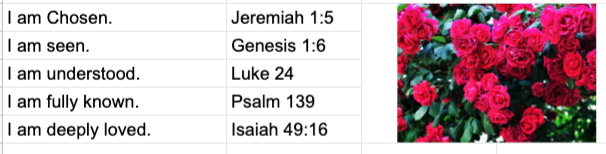
As we press into the theme of identity, here are some verses that will guide my lesson planning, and things I’m declaring over myself, my students, and my colleagues:
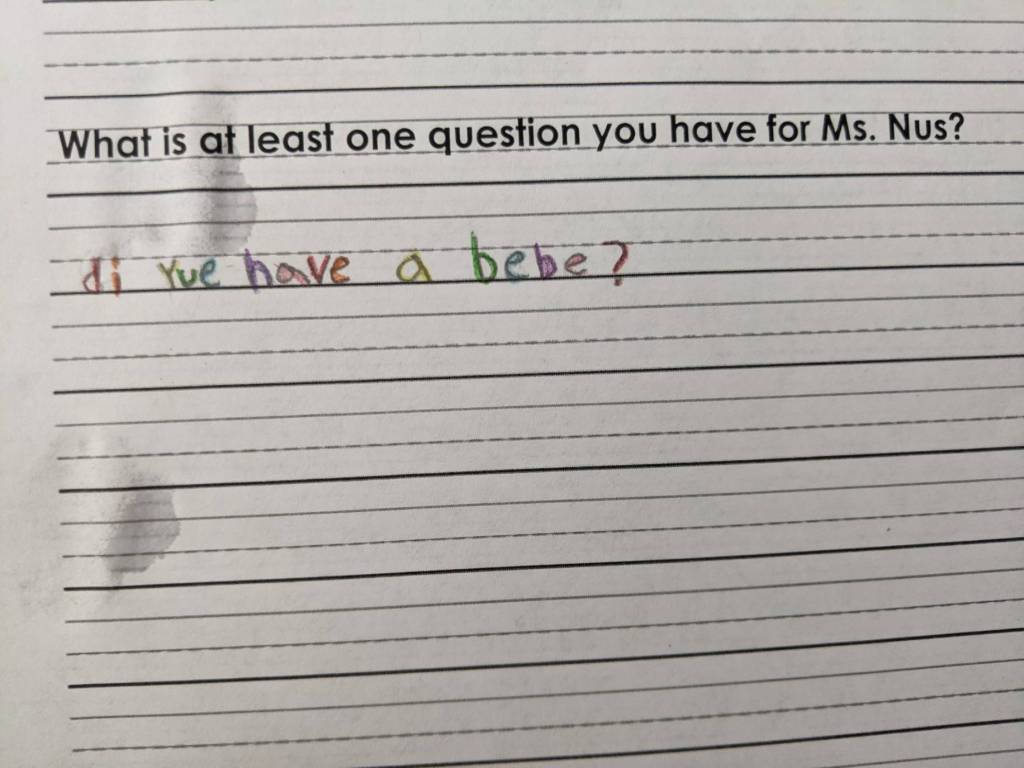
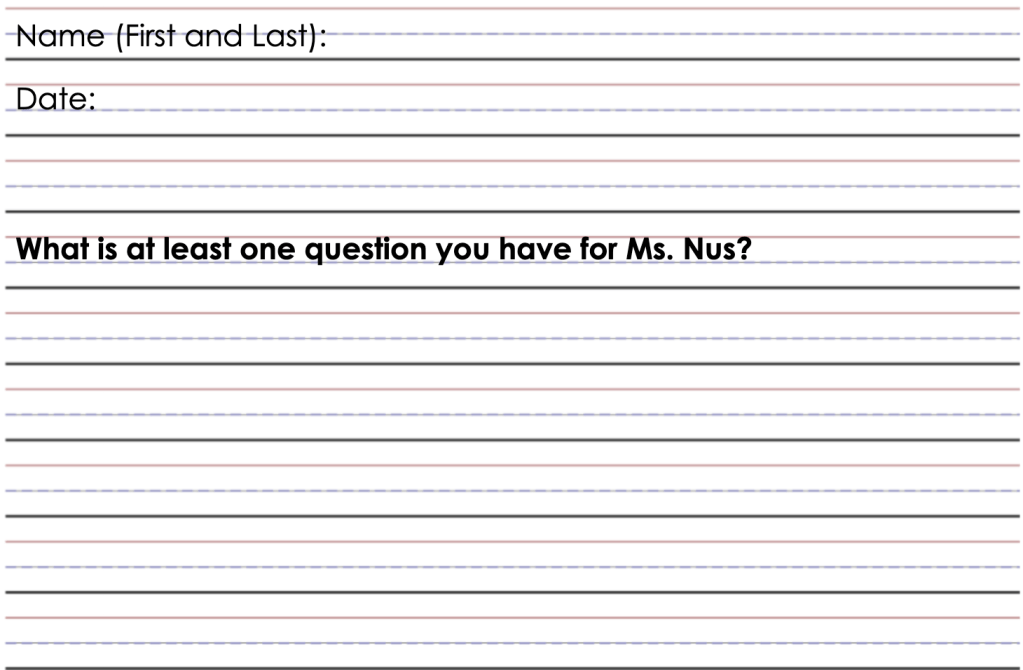
Prior to the start of the school year, one dream I had highlighted some strategies for how to support students well this year, as well as two “get to know you” questions I needed to use with them on Day 1. While simple, the wording of these questions continues to relate to identity: “What is at least one question you have for Ms. Nus?” and “What is at least one thing you want Ms. Nus to know about you?”
In gathering students’ responses to these questions, you can see how eager they are to be known.
In response to students questions, I created this virtual bulletin board. As I watched them eagerly listening, one student asked, “Can we keep asking you questions after this?” My answer was “by all means, yes.”
In particular, the Holy Spirit keeps highlighting to me students who need social connection due to the difficulty of their home experiences. I’ve felt the eyes of these students on me, trying to decide if I am trustworthy. As they have physically sought more closeness, taken risks to ask for help, and been more bold to confide in me this week, the Holy Spirit keeps showing me specific ways to show them that they are loved and deeply known by God. Please pray that God would continue to give myself and my colleagues all the wisdom we need to support these kiddos.
Finally, I’ve been thrilled to re-start my tutoring group with a couple students from my neighborhood. We have been practicing fluency and expression using Reader’s Theater scripts, weaving goofy voices, research, and descriptive writing into our first tutoring session of the fall. It was fun!
Application Ready
As some may remember, this summer, I felt God calling me to apply to the University of Edinburgh’s World Christianity program. Strategically, this program would position me to be studying the history of the Non-western church for a year before I design and prepare my Doctoral thesis. The dates perfectly align, and it would help me make the most out of my current degree program. I also have several friends in Scotland who I’d love to spend time with, and dreams of using this information to support Foundation work within International Christian Education in the future. As of now, I have all the materials ready for my application, and will be submitting it in October.
Other themes with God
August was a month for me of increased dreaming, with significant dreams coming nearly every night. I also experienced a slowing and then an acceleration in my perception of time as I met with Jesus and allowed him to shape my impressions of the coming school year. July seemed to drag on ad infinitim until I let Jesus meet my wrestlessness with a sense of his timelessness. Living from a place of rest in August meant that time seemed to flee behind me, and the days passed fast.
Prayer Requests
Please pray that God would:
Continue to increase the favor on my classroom
Give me a spirit of wisdom to know how to meet the needs of my students and weave my many responsibilities into a cohesive whole, both inside and outside of work
Continue his work of formation and Identity in me, so that I will be more equipped to lead others
Last year, my students did an abundance of research on topics of their own choosing, through Inquiry Projects. My initial goal in developing the Inquiry Projects was to give students’ something other than COVID to define and brighten their experience of distance learning. Throughout the year, the Inquiry Projects became so popular that by May and June, my grade level colleagues joined me to give all Third and Fourth grade students the opportunity to do their own Inquiry Project. Their support was important because throughout the months as the popularity of the projects grew, approximately three students joined our Inquiry Project group each month. I needed support if all students were going to have a chance to keep exploring their interests, and thankfully, my colleagues allowed student’s passions to take over our curriculum.
As a teacher, I also learned a great deal through the Inquiry Projects. In December, I practiced using Seesaw and other digital tools to help students plan their projects. We met over Zoom on Friday mornings, and students frequently got feedback from their peers. Seeing how greatly students valued peer feedback, I placed students in teams that would meet consistently throughout the month to support each other throught discussion (both questions and feedback). Students were required to use their peer feedback in their projects, and we also discussed Internet safety at length, not just focusing on the content of websites, but the emotional and spiritual effect it had on it’s audience. In December, I also expanded the project team to include students with high academic performance but whose standardardized test scores were likely lower than their abilities, due to Spanish as their primary language (and some tests being inevitably based in English, despite how much we try to test bilingually in our bilingual school context). In January, I focused on helping students connect their faith to their research by giving them increased tools to link biblical texts and themes, Catholic saints, and Catholic Social Teaching to their projects. In February and March, I supported students to test out alternative project ideas, including Kahoot, Youtube videos, and Prezi. As our Third and Fourth Grade teaching team decided to expand the Inquiry Project to all students, I supported my team to spend much of May and June making sure that students had both the structure and graphic organizers to develop clear research questions and do a little research day by day. In this post, I will describe the experience of Third graders who had never before completed an Inquiry Project, but who through the tools my team shared were able to draft clear questions and dig deep into their topics.
Interested in learning more about the Inquiry Project content as it developed? Check out these posts.
May/June: All third and fourth grade students (36 total)
Greater Focus on Asking Specific Questions
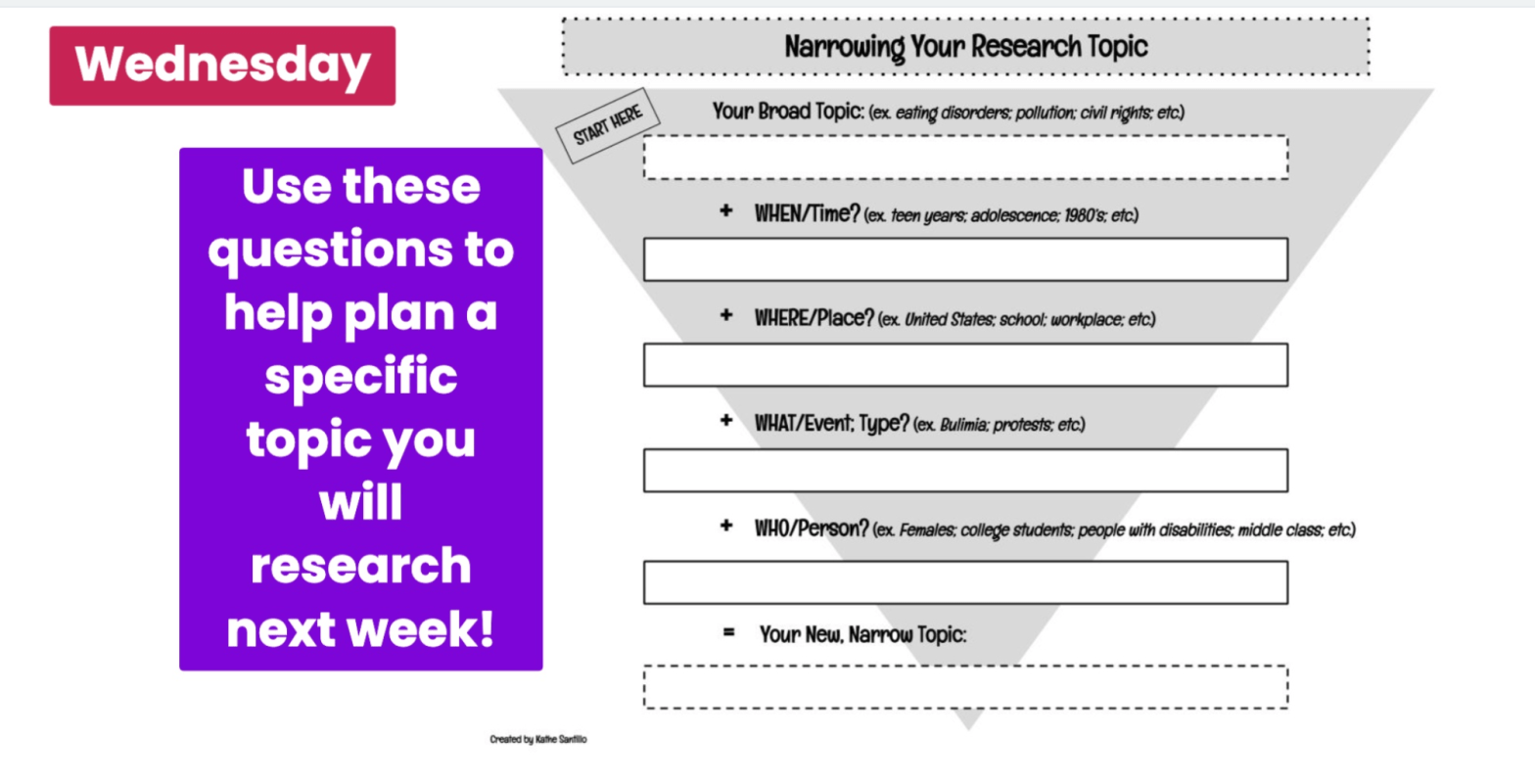
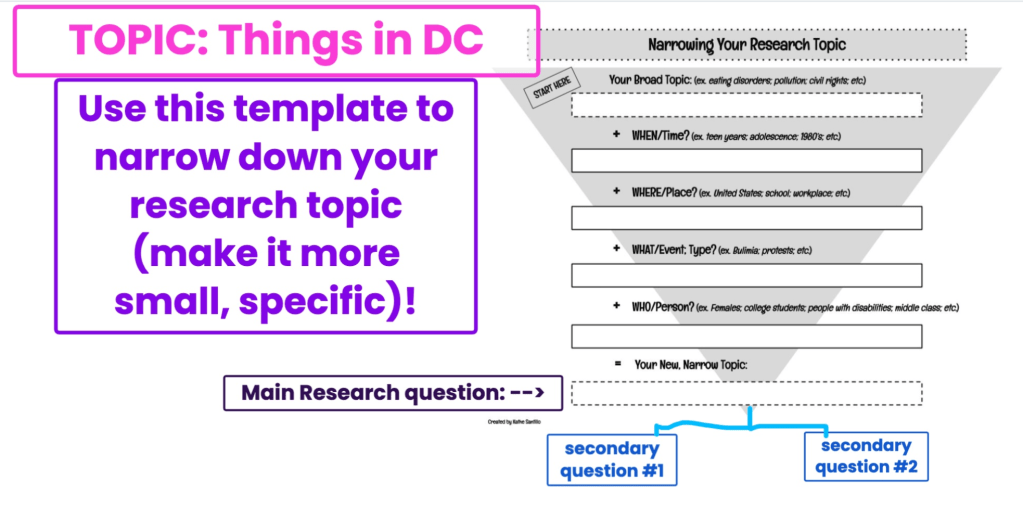
One of the highlights of May and June’s Inquiry Project was seeing how students were able to use this inverted Triangle organizer to ask measurable questions. Through narrowing questions by historical time period, region, type, individuals involved, and other boundaries, students were able to understand not just their topic not just as a genre, but within a set context. In turn, narrowing their research focus allowed them to find more specific information that gave them a deeper understanding of their topic.
One great example of how students applied this skill was by setting the specific breed of animals some researched. By and large, Third grade’s great love of animals became the topic of the majority of their Inquiry Projects. One student who was interested in researching rabbits ultimately chose to research the “American Fuzzy Lops” rabbit, in order to find more specific information. Another example was a student who instead of researching “tigers” chose to research “Sumatran Tigers”. While these changes may seem small, they gave students a sense of greater expertise and confidence come presentation day. Check out this post to find out how Students’ great love of animals has shaped more of our lessons.
Sample Weekly Progression
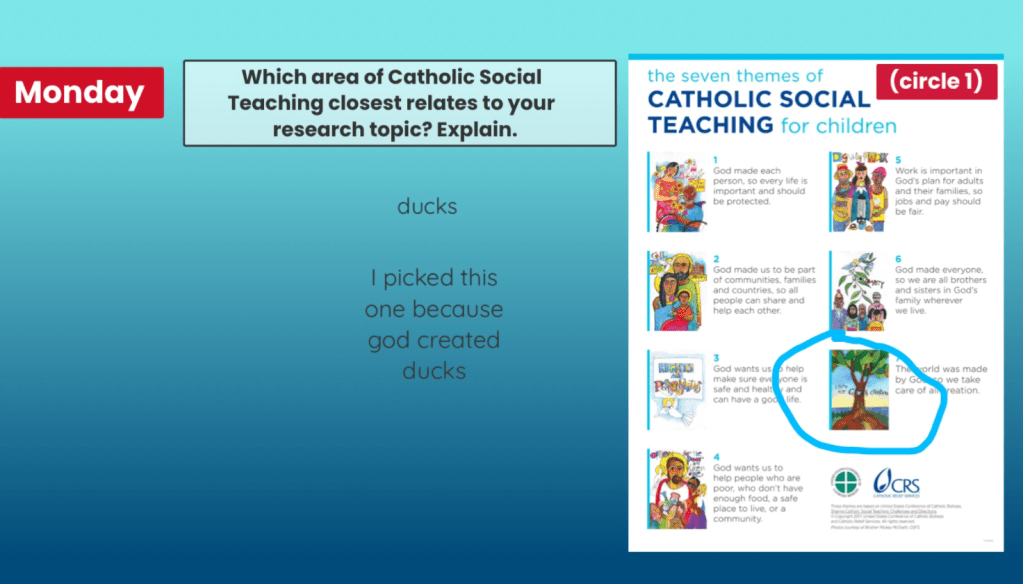
Another excellent change that my colleague pioneered was to break apart the Inquiry project topics not just by week, but by specific activities within the week. While I had previously assigned Fourth Graders one activity for the whole week (a new aspect of the project each week), we agreed as a team that Third grade would have greater difficulty managing their time and breaking the week’s activities into pieces independently. By labeling the activity with specific days of the week, we were able to better support Third AND Fourth graders who struggle with time management. Check out this activity from the “Connecting Faith to Research” week to see how one students’ love of ducks was reflected in Catholic Social Teaching (Monday), the Bible (Tuesday), Catholic Traditions and Saints (Wednesday), and Prayer (Thursday).
Final Projects
Overall, the Third graders did a tremendous amount of work! In the future, we hope to share tools like Youtube, Prezi, or Kahoot with them to give them alternative final presentation formats. For this round of Inquiry Projects, many of them chose to focus on learning how to format a basic Powerpoint.
While just one student chose to create a poster, he was able to use many of the same concepts of Powerpoint creation to his project, from including a blend of photos (at least one per category) to limiting text for simplicity. Overall, I’m extremely proud of the level of detail students’ were able to produce on their first Inquiry Project!
Presenting her Ideas through Video
Several students also chose to record themselves on Seesaw explaining their project instead of presenting their projects live. I have found that students who have difficulty with public speaking prefer this option, as well as students who are verbal processors and just want more talk time. Lastly, I’m starting to find that as students become more passionate about their topic, their excitement makes them more likely to record their voice explaining it. Check out this video I dubbed of a student explaining the function of Electric motors! The passion in her voice comes through!
Reflection
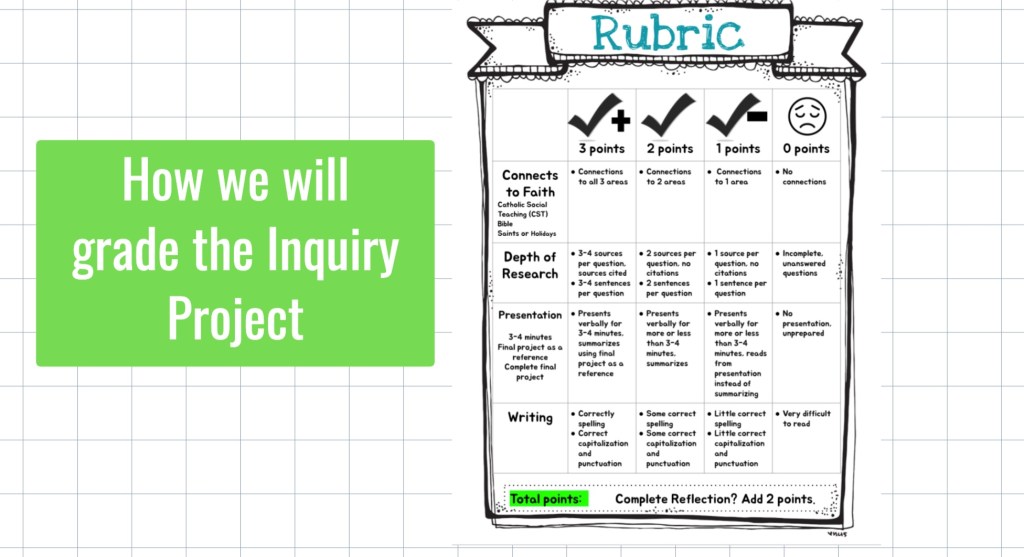
I value reflection so much! I decided to give students this opportunity to reflect, not just to consider the strengths and weaknesses of their project, but also to give students who struggled to meet the rubric requirements a chance to plan ahead for next time.
Again, through these reflections, students’ passions really shone through. I was shocked to see this student admit that she had woken up at 4am one morning to finish her project. I would have never asked that of her, but her level of committment blew me away. She also described her sense of accomplishment when she finished her project.
How will the Inquiry Projects Change this Academic Year (2021-2022)?
Over last year, I so greatly enjoyed seeing the random topics students chose for their projects. From shark attacks to robotics to Dragonball Z to Art murals and Mayan Cuisine, the direction of students’ projects were as diverse as their authors.
I have noticed that the former Third Graders (now Fourth Grade) and our incoming Third Graders (formerly Second Grade) really crave predictability, and need additional support in time management. These developmental delays are no significant challenge, but should be expected after last school year’s experience of distance learning. In order to create a balance of student choice and structure, I have decided to link our Inquiry Projects to the Science and Social Studies block. While students will still connect their projects to their faith and other disciplines, students will be able to have greater support in designing their project topics and pick from a list of genres.
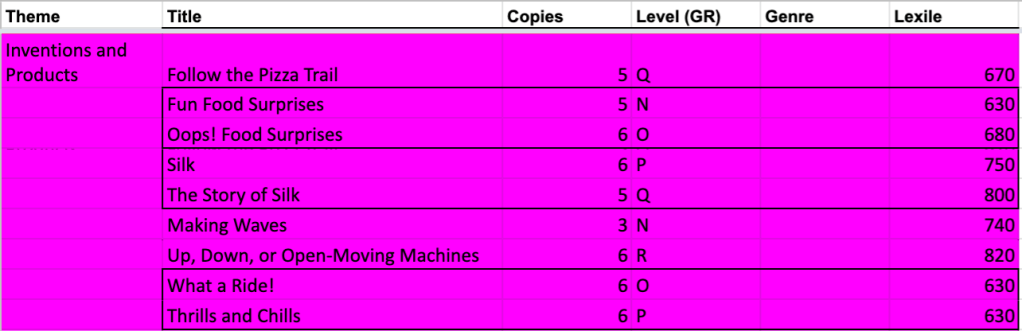
This year, I am hoping to do Inquiry Projects on a monthly cycle that introduces a theme through small group Guided Reading, in the Science or Social Studies Block. By meeting with one group each day for a week to help dive deep into a category of books, I will be able to help compensate for the reading loss students’ experienced last year as well as help them think about related topics (using our Apple TV to research their ideas after finishing a text at their levels). In each topic, there are a variety of books that are at students text levels, so that all Reading Groups will be able to participate (check out the example below). For students whose reading level falls below this range, I can also select a book on Kids A-Z or the Libby App to read as a group, to build students’ background knowledge.
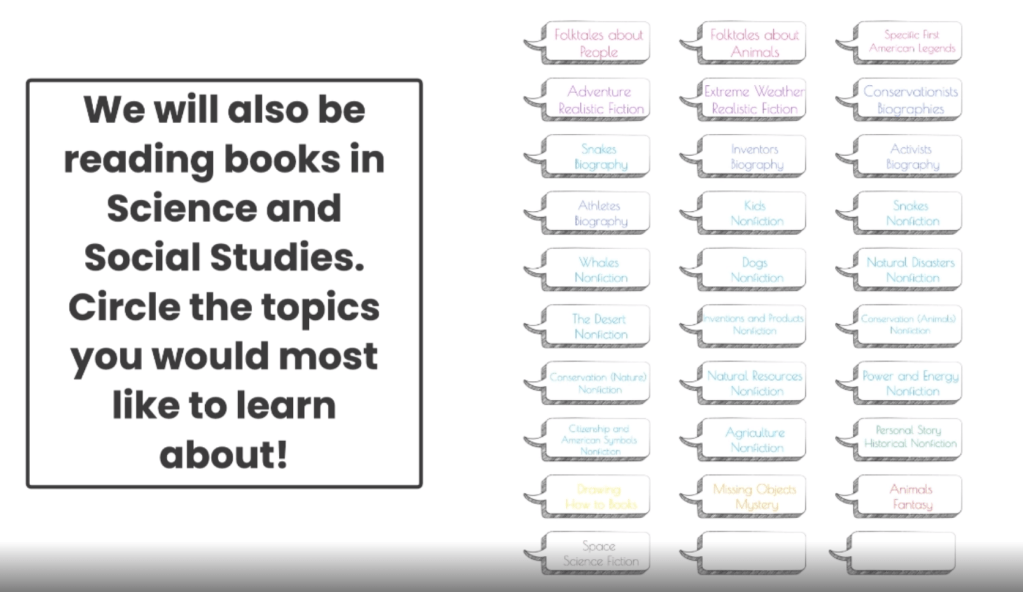
As you can see, there are a variety of topics (sorted by genre and topic) that connect to our Social Studies and Science units (organized by month).
Here are the topics in order:
Topics
Folktales about People
Folktales about Animals
Specific First American Legends
Adventure
Extreme Weather
Conservationists
Doctors and Nurses
Inventors
Activists
Athletes
Kids
Snakes
Whales
Dogs
Natural Disasters
The Desert
Conservation (Animals)
Conservation (Nature)
Natural Resources
Power and Energy
Citizenship and American Symbols
Agriculture
Inventions and Products
Personal Story (?)
Drawing
Missing Objects
Animals
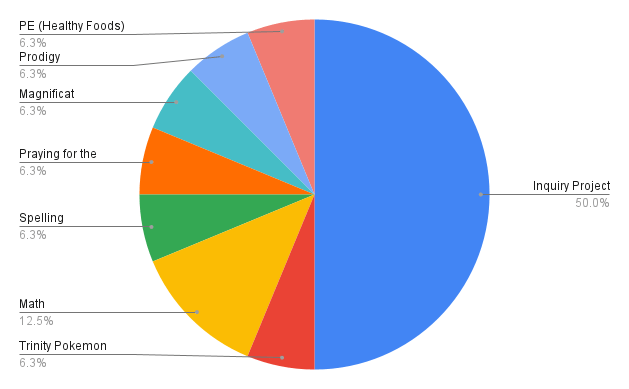
In addition to the Book Interest survey I give students each year, I have assigned students an activity where they can vote on their favorite topics, of the list above.
Through analyzing their responses, I will be able to highlight the categories students are most interested in, both as a class and as groups. I will use this information to plan what Social Studies or Science topics we use in Inquiry Projects this year.
Hopefully, the progression of this project throughout the Month will include:
1 week of Reading books
1 week of Researching Facts
1 week of Researching Faith
1 week of creating Projects (with Presentations during the Morning Meeting the following week, or digitally)
Starting in September
In order to give students’ a chance to respond to their reading interest surveys, I have decided that our first Inquiry Project will connect to our Topic for Social Studies this month: Things in DC. As we focus on what it means to be a school community, biblical teachings on community relationships, and our local context, students will have the opportunity to explore any organization, building, or people group in DC
I am grateful for the support of colleagues and for the hard work of students during 2020-2021 to make these projects possible! I can’t wait to share how students’ interests have continued to propel these projects, the gains they will make in Reading, and the connections they will be able to develop to their faith in and through these projects. Please pray that the Inquiry Project of 2021-2022 would be evenmore fruitful than the projects of 2020-2021, and that students would become more curious, passionate, and faithful through these projects.